

Toronto Proclaims Language Access and Advocacy Day 2026!

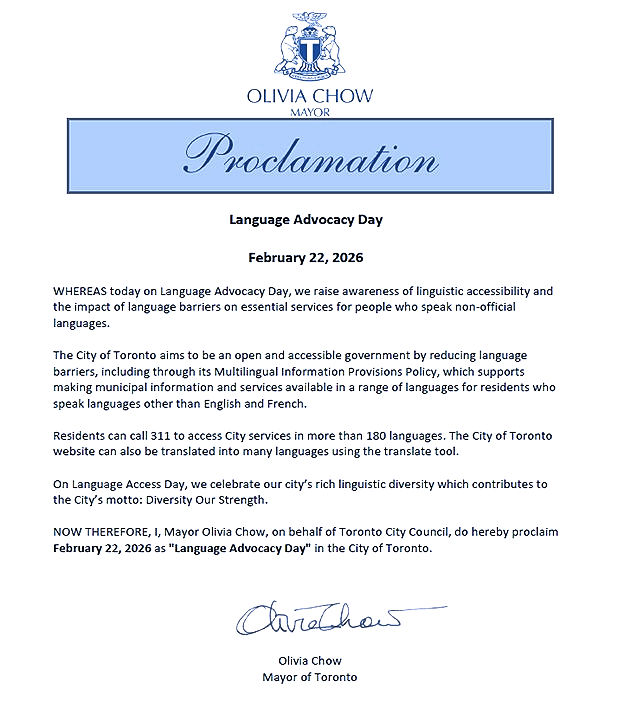
Today, we extend our sincere thanks to the Mayor, Olivia Chow and Members of Toronto City Council for proclaiming February 22, 2026 as Language Advocacy Day!
This proclamation affirms a powerful principle: access to information and services should never be limited by language. In one of the most diverse cities in the world, linguistic inclusion is not optional but essential for equitable governance, public safety, and meaningful civic participation.
By recognizing Language Advocacy Day (#LAD26), City leadership has demonstrated a clear commitment to ensuring that all residents can engage fully in municipal programs, services, and democratic processes. This milestone reflects thoughtful leadership and responsiveness to the lived realities of Toronto’s multilingual communities.
We are grateful for this partnership and look forward to continuing our work with City officials, community organizations, and residents to advance equitable communication and inclusive service delivery across Toronto.
Thank you for leading with inclusion and action.
__________________________________________________________________________________
Date: Jan-26-2026
City of Toronto
Attn: City Council
Re: Request to Proclaim February 22, 2026, as Canadian Language Advocacy Day – Day of Language Access
Dear Members of Toronto City Council,
On behalf of the Language Access Coalition of Canada (LACC), a coalition of over 30 organizations across Ontario and Canada, we respectfully request that the City of Toronto proclaim February 22, 2026, as Canadian Language Advocacy Day – the Day of Language Access.
Language Advocacy Day is a national initiative dedicated to recognizing language access as a fundamental human right and a vital element of civic infrastructure. The 2026 focus is on sustained commitment to linguistic rights and access, and policy support for people who are not fluent in the official languages. Newcomers, refugees, and racialized communities routinely face barriers to interpretation, translation, and culturally responsive services—especially in healthcare, social services, and the justice system.
Toronto officially acknowledged Language Advocacy Day in both 2024 and 2025, reaffirming its commitment to linguistic accessibility and inclusion. We encourage the City to continue this leadership in advancing language rights as human rights, particularly as language access remains a critical concern for many residents. Recent Census data indicates that 42.5% of Torontonians have a mother tongue other than English or French, while 4.5% lack proficiency in either official language. As a result, many residents encounter substantial barriers when accessing essential services such as healthcare, justice, housing, and emergency assistance.
Evidence from across sectors further underscores these challenges. The Canadian Institute for Health Information (CIHI) reports that patients who do not speak English or French experience a 30% higher rate of unintended harmful events during hospital stays, pointing directly to exclusionary communication barriers in clinical settings. In the context of prenatal care decision-making, Ontario health equity monitoring bodies have identified language barriers as a significant obstacle to informed consent in prenatal genetic screening, limiting access to critical decision-making for non-official language speakers.
Additionally, a 2025 Statistics Canada analysis shows that Francophone and allophone adults in Ontario are more likely to receive appropriate care when services are delivered in their language, underscoring the protective effect of linguistic accommodation. Cohort studies of immigrants with limited English proficiency in Ontario further demonstrate higher rates of emergency visits and complications related to chronic conditions such as diabetes, reflecting long-term exclusion in preventive and ongoing care and persistent disparities in chronic disease management.
We acknowledge recent provincial announcements supporting the expansion of French-language government services in six additional areas under the French Language Services Act (FLSA), as well as the federal–provincial bilateral agreement on minority-language education and second official-language instruction for 2024–2028. These actions are welcome, and multilingual communities across Canada stand to benefit from these measures.
However, more must be done to ensure that multilingual speakers, many of whom work in occupations deemed essential such as personal support, grocery services, and cleaning, do not fall further behind. These challenges are compounded with advancement of Artificial Intelligence, for women and gender-diverse people, individuals who belong to Black, Indigenous, and racialized communities, newcomers and those with precarious immigration status, and people with physical and invisible disabilities. Language access concerns extend beyond service delivery to issues of technology, data privacy, mitigation of algorithmic biases, employment, working conditions, housing, and political representation.
To advance language rights as human rights, we call for the following to be considered for inclusion in the proclamation:
Proclaim February 22nd as the Day of Language Access, recognizing the importance of linguistic inclusion and affirming Toronto’s leadership in supporting diverse communities.
Implement a comprehensive AI ethical risk assessment governing the use of AI in language services, translation and interpretation, ensuring transparency, accountability, bias mitigation, data privacy safeguards, human oversight, community consultation, accessibility, multilingual equity, procurement standards, and ongoing audit mechanisms.
Implement an “active offer” of language services across municipal services, particularly in healthcare, housing, and social support, so residents are proactively informed of available interpretation and translation options.
Provide certified ASL and LSQ interpretation for all public announcements and emergency communications, ensuring accessibility for Deaf and hard-of-hearing residents.
Increase support for Indigenous language education and revitalization, aligning with reconciliation efforts and affirming Indigenous language rights within Toronto’s civic framework.
These recommendations uphold Toronto’s priorities of equity, accessibility, and community engagement. They build on the City’s existing commitment to multilingual service, exemplified by the Multilingual Information Provisions Policy and 311 language support, and promote fair and equitable access to all City services.
Sincerely,
Aurelia Klimkiewicz, PhD, Associate Professor, Department of Global Communication and Cultures, Glendon College, York University
Eliana Trinaistic, Director, Social Purpose, Impact and Culture, MCIS Language Solutions
Craig Carter-Edwards, Policy Analyst, LACC Strategist 2021–23
Grace Eagan, Director, Language Services & Digital Strategy, Access Alliance Multicultural Health & Community Services
Irina Vasilyeva. Director, Learner Experience, Loyalist College
Latha Sukumar, Executive Director, MCIS Language Solutions
Lola Bendana, Director, Multi-Languages Corporation
Nancy Bell, PhD, Associate Professor, Ontario Institute for Studies in Education, University of Toronto
Shash Anand, Senior Vice President of Product Strategy, SOTI
Sylvie Rosienski-Pellerin, Associate Professor, Global and Cultural Affairs, York University (Glendon College)



Comments